A year-long investigation by the Associated Press has found that seafood caught by slaves in Indonesia is sent to Thailand, where the fish can wind up in the supply chains of Wal-mart, Kroger, Albertsons, and Safeway. (March 24)
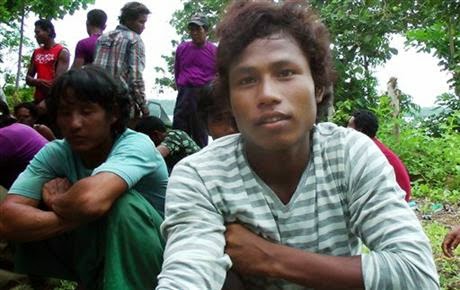
BENJINA, Indonesia (AP) — The Burmese slaves sat on the floor and stared through the rusty bars of their locked cage, hidden on a tiny tropical island thousands of miles from home.
Just a few yards away, other workers loaded cargo ships with slave-caught seafood that clouds the supply networks of major supermarkets, restaurants and even pet stores in the United States.
But the eight imprisoned men were considered flight risks — laborers who might dare run away. They lived on a few bites of rice and curry a day in a space barely big enough to lie down, stuck until the next trawler forces them back to sea.
"All I did was tell my captain I couldn't take it anymore, that I wanted to go home," said Kyaw Naing, his dark eyes pleading into an Associated Press video camera sneaked in by a sympathetic worker. "The next time we docked," he said nervously out of earshot of a nearby guard, "I was locked up."
Here, in the Indonesian island village of Benjina and the surrounding waters, hundreds of trapped men represent one of the most desperate links criss-crossing between companies and countries in the seafood industry. This intricate web of connections separates the fish we eat from the men who catch it, and obscures a brutal truth: Your seafood may come from slaves.
The men the AP interviewed on Benjina were mostly from Myanmar, also known as Burma, one of the poorest countries in the world. They were brought to Indonesia through Thailand and forced to fish. Their catch was then shipped back to Thailand, where it entered the global stream of commerce.
Tainted fish can wind up in the supply chains of some of America's major grocery stores, such as Kroger, Albertsons and Safeway; the nation's largest retailer, Wal-Mart; and the biggest food distributor, Sysco. It can find its way into the supply chains of some of the most popular brands of canned pet food, including Fancy Feast, Meow Mix and Iams. It can turn up as calamari at fine dining restaurants, as imitation crab in a California sushi roll or as packages of frozen snapper relabeled with store brands that land on our dinner tables.
In a year-long investigation, the AP talked to more than 40 current and former slaves in Benjina. The AP documented the journey of a single large shipment of slave-caught seafood from the Indonesian village, tracking it by satellite to a gritty Thai harbor. Upon its arrival, AP journalists followed trucks that loaded and drove the seafood over four nights to dozens of factories, cold storage plants and the country's biggest fish market.
The tainted seafood mixes in with other fish at a number of sites in Thailand, including processing plants. U.S. Customs records show that several of those Thai factories ship to America. They also sell to Europe and Asia, but the AP traced shipments to the U.S., where trade records are public.
By this time, it is nearly impossible to tell where a specific fish caught by a slave ends up. However, entire supply chains are muddied, and money is trickling down the line to companies that benefit from slave labor.
The major corporations contacted would not speak on the record but issued statements that strongly condemned labor abuses. All said they were taking steps to prevent forced labor, such as working with human rights groups to hold subcontractors accountable.
Several independent seafood distributors who did comment described the costly and exhaustive steps taken to ensure their supplies are clean. They said the discovery of slaves underscores how hard it is to monitor what goes on halfway around the world.
Santa Monica Seafood, a large independent importer that sells to restaurants, markets and direct from its store, has been a leader in improving international fisheries, and sends buyers around the world to inspect vendors.
"The supply chain is quite cloudy, especially when it comes from offshore," said Logan Kock, vice president for responsible sourcing, who acknowledged that the industry recognizes and is working to address the problem. "Is it possible a little of this stuff is leaking through? Yeah, it is possible. We are all aware of it."
The slaves interviewed by the AP had no idea where the fish they caught was headed. They knew only that it was so valuable, they were not allowed to eat it.
They said the captains on their fishing boats forced them to drink unclean water and work 20- to 22-hour shifts with no days off. Almost all said they were kicked, whipped with toxic stingray tails or otherwise beaten if they complained or tried to rest. They were paid little or nothing, as they hauled in heavy nets with squid, shrimp, snapper, grouper and other fish.
Some shouted for help over the deck of their trawler in the port to reporters, as bright fluorescent lights silhouetted their faces in the darkness.
"I want to go home. We all do," one man called out in Burmese, a cry repeated by others. The AP is not using the names of some men for their safety. "Our parents haven't heard from us for a long time. I'm sure they think we are dead."
Another glanced fearfully over his shoulder toward the captain's quarters, and then yelled: "It's torture. When we get beaten, we can't do anything back. ... I think our lives are in the hands of the Lord of Death."
In the worst cases, numerous men reported maimings or even deaths on their boats.
"If Americans and Europeans are eating this fish, they should remember us," said Hlaing Min, 30, a runaway slave from Benjina. "There must be a mountain of bones under the sea. ... The bones of the people could be an island, it's that many."
_______
For Burmese slaves, Benjina is the end of the world.
Roughly 3,500 people live in the town that straddles two small islands separated by a five-minute boat ride. Part of the Maluku chain, formerly known as the Spice Islands, the area is about 400 miles north of Australia, and hosts small kangaroos and rare birds of paradise with dazzling bright feathers.
Benjina is impossible to reach by boat for several months of the year, when monsoon rains churn the Arafura Sea. It is further cut off by a lack of Internet access. Before a cell tower was finally installed last month, villagers would climb nearby hills each evening in the hope of finding a signal strong enough to send a text. An old landing strip has not been used in years.
The small harbor is occupied by Pusaka Benjina Resources, whose five-story office compound stands out and includes the cage with the slaves. The company is the only fishing operation on Benjina officially registered in Indonesia, and is listed as the owner of more than 90 trawlers. However, the captains are Thai, and the Indonesian government is reviewing to see if the boats are really Thai-owned. Pusaka Benjina did not respond to phone calls and a letter, and did not speak to a reporter who waited for two hours in the company's Jakarta office.
On the dock in Benjina, former slaves unload boats for food and pocket money. Many are men who were abandoned by their captains — sometimes five, 10 or even 20 years ago — and remain stranded.
In the deeply forested island interiors, new runaways forage for food and collect rainwater, living in constant fear of being found by hired slave catchers.
And just off a beach covered in sharp coral, a graveyard swallowed by the jungle entombs dozens of fishermen. They are buried under fake Thai names given to them when they were tricked or sold onto their ships, forever covering up evidence of their captors' abuse, their friends say.
"I always thought if there was an entrance there had to be an exit," said Tun Lin Maung, a slave abandoned on Benjina, as other men nodded or looked at the ground. "Now I know that's not true."
The Arafura Sea provides some of the world's richest and most diverse fishing grounds, teeming with mackerel, tuna, squid and many other species.
Although it is Indonesian territory, it draws many illegal fishing fleets, including from Thailand. The trade that results affects the United States and other countries.
The U.S. counts Thailand as one of its top seafood suppliers, and buys about 20 percent of the country's $7 billion annual exports in the industry. Last year, the State Department blacklisted Thailand for failing to meet minimum standards in fighting human trafficking, placing the country in the ranks of North Korea, Syria and Iran. However, there were no additional sanctions.
Thailand's seafood industry is largely run off the backs of migrant laborers, said Kendra Krieder, a State Department analyst who focuses on supply chains. The treatment of some of these workers falls under the U.S. government's definition of slavery, which includes forcing people to keep working even if they once signed up for the jobs, or trafficking them into situations where they are exploited.
"In the most extreme cases, you're talking about someone kidnapped or tricked into working on a boat, physically beaten, chained," said Krieder. "These situations would be called modern slavery by any measure."
The Thai government says it is cleaning up the problem. On the bustling floor of North America's largest seafood show in Boston earlier this month, an official for the Department of Fisheries laid out a plan to address labor abuse, including new laws that mandate wages, sick leave and shifts of no more than 14 hours. However, Kamonpan Awaiwanont stopped short when presented details about the men in Benjina.
"This is still happening now?" he asked. He paused. "We are trying to solve it. This is ongoing."
The Thai government also promises a new national registry of illegal migrant workers, including more than 100,000 flooding the seafood industry. However, policing has now become even harder because decades of illegal fishing have depleted stocks close to home, pushing the boats farther and deeper into foreign waters.
The Indonesian government has called a temporary ban on most fishing, aiming to clear out foreign poachers who take billions of dollars of seafood from the country's waters. As a result, more than 50 boats are now docked in Benjina, leaving up to 1,000 more slaves stranded onshore and waiting to see what will happen next.
Indonesian officials are trying to enforce laws that ban cargo ships from picking up fish from boats at sea. This practice forces men to stay on the water for months or sometimes years at a time, essentially creating floating prisons.
Susi Pudjiastuti, the new Fisheries Minister, said she has heard of different fishing companies putting men in cells. She added that she believes the trawlers on Benjina may really have Thai owners, despite the Indonesian paperwork, reflecting a common practice of faking or duplicating licenses.
She said she is deeply disturbed about the abuse on Benjina and other islands.
"I'm very sad. I lose my eating appetite. I lose my sleep," she said. "They are building up an empire on slavery, on stealing, on fish(ing) out, on massive environmental destruction for a plate of seafood."
_________
The story of slavery in the Thai seafood industry started decades ago with the same push-and-pull that shapes economic immigration worldwide — the hope of escaping grinding poverty to find a better life somewhere else.
In recent years, as the export business has expanded, it has become more difficult to convince young Burmese or Cambodian migrants and impoverished Thais — all of whom were found on Benjina — to accept the dangerous jobs. Agents have become more desperate and ruthless, recruiting children and the disabled, lying about wages and even drugging and kidnapping migrants, according to a former broker who spoke on condition of anonymity to avoid retribution.
The broker said agents then sell the slaves, usually to Thai captains of fishing boats or the companies that own them. Each slave typically costs around $1,000, according to Patima Tungpuchayakul, manager of the Thai-based nonprofit Labor Rights Promotion Network Foundation. The men are later told they have to work off the "debt" with wages that don't come for months or years, or at all.
"The employers are probably more worried about the fish than the workers' lives," she said. "They get a lot of money from this type of business."
Illegal Thai boats are falsely registered to fish in Indonesia through graft, sometimes with the help of government authorities. Praporn Ekouru, a Thai former member of Parliament, admitted to the AP that he had bribed Indonesian officials to go into their waters, and complained that the Indonesian government's crackdown is hurting business.
"In the past, we sent Thai boats to fish in Indonesian waters by changing their flags," said Praporn, who is also chairman of the Songkhla Fisheries Association in southern Thailand. "We had to pay bribes of millions of baht per year, or about 200,000 baht ($6,100) per month. ... The officials are not receiving money anymore because this order came from the government."
Illegal workers are given false documents, because Thai boats cannot hire undocumented crew. One of the slaves in Benjina, Maung Soe, said he was given a fake seafarer book belonging to a Thai national, accepted in Indonesia as an informal travel permit. He rushed back to his boat to dig up a crinkled copy.
"That's not my name, not my signature," he said angrily, pointing at the worn piece of paper. "The only thing on here that is real is my photograph."
Soe said he had agreed to work on a fishing boat only if it stayed in Thai waters, because he had heard Indonesia was a place from which workers never came back.
"They tricked me," he said. "They lied to me. ... They created fake papers and put me on the boat, and now here I am in Indonesia."
The slaves said the level of abuse on the fishing boats depends on individual captains and assistants. Aung Naing Win, who left a wife and two children behind in Myanmar two years ago, said some fishermen were so depressed that they simply threw themselves into the water. Win, 40, said his most painful task was working without proper clothing in the ship's giant freezer, where temperatures drop to 39 degrees below zero.
"It was so cold, our hands were burning," he said. "No one really cared if anyone died."
________
The shipment the AP tracked from the port of Benjina carried fish from smaller trawlers; AP journalists talked to slaves on more than a dozen of them.
A crane hoisted the seafood onto a refrigerated cargo ship called the Silver Sea Line, with an immense hold as big as 50 semi-trucks. At this point, by United Nations and U.S. standards, every fish in that hold is considered associated with slavery.
The ship belongs to the Silver Sea Reefer Co., which is registered in Thailand and has at least nine refrigerated cargo boats. The company said it is not involved with the fishermen.
"We only carry the shipment and we are hired in general by clients," said owner Panya Luangsomboon. "We're separated from the fishing boats."
The AP followed the Silver Sea Line by satellite over 15 days to Samut Sakhon. When it arrived, workers on the dock packed the seafood over four nights onto more than 150 trucks, which then delivered their loads around the city.
One truck bore the name and bird logo of Kingfisher Holdings Ltd., which supplies frozen and canned seafood around the world. Another truck went to Mahachai Marine Foods Co., a cold storage business that also supplies to Kingfisher and other exporters, according to Kawin Ngernanek, whose family runs it.
"Yes, yes, yes, yes," said Kawin, who also serves as spokesman for the Thai Overseas Fisheries Association. "Kingfisher buys several types of products."
When asked about abusive labor practices, Kingfisher did not answer repeated requests for comment. Mahachai manager Narongdet Prasertsri responded, "I have no idea about it at all."
Every month, Kingfisher and its subsidiary KF Foods Ltd. sends about 100 metric tons of seafood from Thailand to America, according to U.S. Customs Bills of Lading. These shipments have gone to Santa Monica Seafood, Stavis Seafoods — located on Boston's historic Fish Pier — and other distributors.
Richard Stavis, whose grandfather started the dealership in 1929, shook his head when told about the slaves whose catch may end up at businesses he buys from. He said his company visits processors and fisheries, requires notarized certification of legal practices and uses third-party audits.
"The truth is, these are the kind of things that keep you up at night," he said. "That's the sort of thing I want to stop. ... There are companies like ours that care and are working as hard as they can."
Wholesalers like Stavis sell packages of fish, branded and unbranded, that can end up on supermarket shelves with a private label or house brand. Stavis' customers also include Sysco, the largest food distributor in the U.S.; there is no clear way to know which particular fish was sold to them.
Sysco declined an interview, but the company's code of conduct says it "will not knowingly work with any supplier that uses forced, bonded, indentured or slave labor."
Gavin Gibbons, a spokesman for National Fisheries Institute, which represents about 75 percent of the U.S. seafood industry, said the reports of abuse were "disturbing" and "disheartening." ''But these type of things flourish in the shadows," he said.
A similar pattern repeats itself with other shipments and other companies, as the supply chain splinters off in many directions in Samut Sakhon. It is in this Thai port that slave-caught seafood starts to lose its history.
The AP followed another truck to Niwat Co., which sells to Thai Union Manufacturing Co., according to part owner Prasert Luangsomboon. Weeks later, when confronted about forced labor in their supply chain, Niwat referred several requests for comment to Luangsomboon, who could not be reached for further comment.
Thai Union Manufacturing is a subsidiary of Thai Union Frozen Products PCL., the country's largest seafood corporation, with $3.5 billion in annual sales. This parent company, known simply as Thai Union, owns Chicken of the Sea and is buying Bumble Bee, although the AP did not observe any tuna fisheries. In September, it became the country's first business to be certified by Dow Jones for sustainable practices, after meeting environmental and social reviews.
Thai Union said it condemns human rights violations, but multiple stakeholders must be part of the solution. "We all have to admit that it is difficult to ensure the Thai seafood industry's supply chain is 100 percent clean," CEO Thiraphong Chansiri said in an emailed statement.
Thai Union ships thousands of cans of cat food to the U.S., including household brands like Fancy Feast, Meow Mix and Iams. These end up on shelves of major grocery chains, such as Kroger, Safeway and Albertsons, as well as pet stores; again, however, it's impossible to tell if a particular can of cat food might have slave-caught fish.
Thai Union says its direct clients include Wal-Mart, which declined an interview but said in an email statement: "We care about the men and women in our supply chain, and we are concerned about the ethical recruitment of workers."
Wal-Mart described its work with several non-profits to end forced labor in Thailand, including Project Issara, and referred the AP to Lisa Rende Taylor, its director. She noted that slave-caught seafood can slip into supply chains undetected at several points, such as when it is traded between boats or mingles with clean fish at processing plants. She also confirmed that seafood sold at the Talay Thai market — to where the AP followed several trucks — can enter international supply chains.
"Transactions throughout Thai seafood supply chains are often not well-documented, making it difficult to estimate exactly how much seafood available on supermarket shelves around the world is tainted by human trafficking and forced labor," she said.
Poj Aramwattananont, president of an industry group that represents Thai Union, Kingfisher and others, said Thais are not "jungle people" and know that human trafficking is wrong. However, he acknowledged that Thai companies cannot always track down the origins of their fish.
"We don't know where the fish come from when we buy from Indonesia," said Poj of the Thai Frozen Foods Association. "We have no record. We don't know if that fish is good or bad."
______
The seafood the slaves on Benjina catch may travel around the world, but their own lives often end right here, in this island village.
A crude cemetery holds more than graves strangled by tall grasses and jungle vines, where small wooden markers are neatly labelled, some with the falsified names of slaves and boats. Only their friends remember where they were laid to rest.
In the past, former slave Hla Phyo said, supervisors on ships simply tossed bodies into the sea to be devoured by sharks. But after authorities and companies started demanding that every man be accounted for on the roster upon return, captains began stowing corpses alongside the fish in ship freezers until they arrived back in Benjina, the slaves said.
Lifting his knees as he stepped over the thick brush, Phyo searched for two grave markers overrun by weeds — friends he helped bury.
It's been five years since he himself escaped the sea and struggled to survive on the island. Every night, his mind drifts back to his mother in Myanmar. He knows she must be getting old now, and he desperately wants to return to her. Standing among so many anonymous tombs stacked on top of each other, hopelessness overwhelms him.
"I'm starting to feel like I will be in Indonesia forever," he said, wiping a tear away. "I remember thinking when I was digging, the only thing that awaits us here is death."
___
Esther Htusan contributed to this report from Benjina, Indonesia. Mason reported from Samut Sakhon, Thailand; Mendoza reported from Boston, Massachusetts.
AP By ROBIN MCDOWELL, MARGIE MASON and MARTHA MENDOZA
Speaking at the London School of Economics, the Burmese pro-democracy
campaigner argues progress in the country depends on an understanding of the
rule of law, saying justice cannot be done unless it is seen to be done.
Aung San Suu Kyi started a week-long visit to Britain on Tuesday, her
67th birthday, telling hundreds of students and academics that time alone
will not heal the wounds of her country.
Her first public event in the UK was a debate at the London School of
Economics on how Burma can move to the rule of law, a reminder of the tough
road ahead for the leader of the Southeast Asian country's reform movement.
Ms Suu Kyi told the audience that time alone "will not heal" Burma
and "there has to be acknowledgment" of the wrongs of the past.
"The progress that we hope to make with regard to democratisation and
reform," she said, "depends so much on an understanding of the
importance of the rule of law."
Ms Suu Kyi, who is on her first overseas trip since 1988, received a standing
ovation as she took the stage during the panel discussion.
PYONGYANG, North Korea (AP) — North Korea's military vowed Monday to launch unspecified "special actions" soon meant to reduce South Korea's conservative government and media companies "to ashes" in less that four minutes, in an escalation of its recent threats.
North Korea regularly criticizes Seoul and just last week renewed its promise to wage a "sacred war," saying South Korean President Lee Myung-bak had insulted the North's April 15 celebrations of the birth centennial of national founder Kim Il Sung.
But
Monday's military statement, which vowed actions of "unprecedented
peculiar means," was unusual in promising something soon and describing a
specific length of time.
The
threat follows U.N. condemnation of North Korea's launch of a long-range
rocket that exploded shortly after liftoff April 13. Washington, Seoul
and others called the launch a cover for testing long-range missile
technology. Pyongyang said the launch was meant to put a satellite into
orbit.
The North's
special actions "will reduce all the rat-like groups and the bases for
provocations to ashes in three or four minutes, (or) in much shorter
time, by unprecedented peculiar means and methods of our own style,"
according to the statement by the special operation action group of the
Korean People's Army's Supreme Command.
Some South Korean analysts
speculated the North's statement was meant to unnerve Seoul; others
that the North could be planning terrorist attacks.
It seemed
unlikely that North Korea would launch a large-scale military attack
against Seoul, which is backed by nearly 30,000 U.S. troops stationed in
the South, said Kim Young-soo, a professor at Sogang University in
Seoul.
The North's latest threat, which was carried by its state
media, comes amid rising tensions on the Korean peninsula, with both
Koreas recently unveiling new missiles.
The animosity has prompted
worries that North Korea may conduct a new nuclear test — something it
did after rocket launches in 2006 and 2009. South Korean intelligence
officials have said that recent satellite images show North Korea has
been digging a new tunnel in what appears to be preparation for a third
nuclear test.
South Korea's Unification Ministry said it was
examining North Korea's intentions behind the statement; the Defense
Ministry said no special military movement had been observed in the
North. Officials spoke on condition of anonymity, citing office rules.
Relations
between the Koreas have been abysmal since Lee took office in 2008 with
a hard-line policy that ended unconditional aid shipments to the North.
In
Beijing, North Korea's biggest ally, China's top foreign policy
official met Sunday with a North Korean delegation and expressed
confidence in the country's new young leader, Kim Jong Un.
___
Associated Press writers Youkyung Lee and Jiyoung Won contributed to this report from Seoul.
TOKYO: Myanmar's president said on Monday he has no plans to change the loyalty oath that has provoked an announcement by democracy leader Aung San Suu Kyi to boycott parliament, Kyodo reported.
Thein Sein told reporters in Tokyo he would like to "welcome" the Nobel Peace prize winner to parliament, but that it was up to her whether or not she took the seat she won earlier this month.
MANILA, Philippines — The 20th Summit Meeting of the Association of Southeast Asian Nations (ASEAN) held this year in Cambodia, concluded on April 4th after two intensive days, in which leaders of the 10 ASEAN countries – Brunei, Cambodia, Indonesia, Laos, Malaysia, Myanmar, the Philippines, Singapore, Thailand, and Vietnam – tackled problems of regional security, human rights and illegal drugs. Making his first trip abroad this year to Cambodia, President Aquino pushed for the creation of a legally binding Code of Conduct to address the conflicting claims in the South China Sea. While in Phnom Penh, he also took the occasion to oversee the negotiation of a Free Trade Agreement that would allow tariff-free raw materials to move from one country to another, and he urged North Korea to cancel its rocket launch, suggesting that North Korea could better spend its resources on food security.
The host of this year’s ASEAN summit meeting, Cambodian Prime Minister Hun Sen, urged fellow members to strengthen their cooperation in preparation for the proposed integration of the 10-nation regional bloc in 2015 and work toward the realization of one ASEAN community which would include a single investment system to facilitate the free flow of goods and services and labor. He also cautioned the other leaders to respect the rights of migrant workers, oversee the scrapping of trade barriers, and ensure that necessary infrastructure is being developed.
ASEAN will launch a $485-million infrastructure fund next month. Co-financed by ASEAN and the Asian Development Bank (ADB), the fund is designed to provide financing for infrastructure projects in the region. The Philippines intends to present several project proposals.
Following the election in Myanmar, on April 1st in which democracy activist Aung San Suu Kyi was elected to a seat in Parliament, the leaders of the ASEAN countries called on Western countries to lift their sanctions on Myanmar “immediately in light of significant positive developments.”
Myanmar’s most powerful ally, China, also welcomed the election victory. During the period when sanctions blocked any investment from the West, China took the opportunity to invest heavily in Myanmar’s inadequate infrastructure, building much-needed hydropower dams and oil and gas pipelines which facilitate the export of Myanmar’s oil and gas reserves, and help with South China’s growing energy needs.
In 1989, following the collapse of the Communist Party of Burma (CPB), a number of armed ethnic armies entered into a series of ceasefire agreements with Rangoon. The fighting stopped, to a degree, but deep down nobody believed it would last. It was just a matter of time before the various groups resumed fighting. For more than two decades, the so-called peace deals rested on shaky ground with little effort to resolve differences and allow them to integrate into Burmese society and administration. The ethnic armies held their turf, running special administrative areas with a high degree of autonomy. Some entered into the lucrative drug trade. Others went into logging and gems. The ceasefire deals were the work of former security tsar General Khin Nyunt in the years following the bloody crackdown on huge nationwide pro-democracy demonstrations in 1988. But with the regime intelligence chief ousted and put under house arrest in October 2004, things haven't been the same. Hardliners in junta were determined to disband the ethnic armies and put them under the command of the country's notorious army, locally known as the Tatmadaw. Other groups who refused to come into the "legal fold", such as the Karen National Union, continued their armed struggle. Gross human rights violations have been committed for many years as the Tatmadaw classed civilians in areas where rebel forces were active as allies of enemy fighters. Rangoon intentionally uprooted and attacked civilians in a bid to deny rebel groups any form of support. This tactic, part of the notorious 'Four Cuts' policy, displaced hundreds of thousands of villagers, many of whom made their way to refugee camps dotted along the Thai-Burma border. But the Tatmadaw didn't stop there. Rape was has long been employed as part of their ugly tactics to demoralise ethnic armies and the local population. A hard-hitting report released in 2002 by the Shan Women's Action Network (SWAN) - 'A Licence to Rape' - outlined in great detail the use of such a despicable ploy. International organisations and foreign governments looked into the allegations and confirmed the practice really was occurring. That was nine years ago. The junta denied it - as they do with virtually every accusation - but things appear to have hardly changed over the past decade. Today, with a number of former ceasefire groups facing the guns of the Burmese military, the use of rape has extended to women from these ethnic communities as well. At this moment, the northern part of Shan State is the centre of attention. The area is of "crucial strategic importance for Burma's military rulers, who are seeking to secure it for major Chinese investments, including hydropower dams and transnational gas and oil pipelines," according to a recent statement released by SWAN and the Shan Human Rights Foundation (SHRF). "Foreign governments dealing with Burma should not be silent about these atrocities. 'Business as usual' means ongoing rape in our communities," SWAN's Hseng Moon said. The latest report about rapes in Shan State comes only weeks after the Kachin Women's Association Thailand denounced the rape of 18 women and girls during renewed fighting last month in Kachin State in the far north. Rape brings stigma, shame, and reluctance on the part of victims to speak out about what happened to them. But an increasing number of women and girls from Burma - the ones that survived - have begun to tell of their experiences of rape and other forms of sexual violence in the country's war-torn areas. Burmese Army deserters confirm that rapes occur regularly and usually go unpunished. The UN Special Rapporteur on violence against women has published material that corroborates details in 'A Licence to Rape' and adds many new cases. Nevertheless, years on, a UN investigation has yet to take place, because the military junta refuses to grant the UN access to the country. Incidents of rape continue to be reported, and the Burmese military must surely know what is happening. But the junta engages in Orwellian double-speak. It has rejected the reports, instead launching its own investigations, which are conducted in such a manner one can hardly have confidence in their credibility. While the United Nations and a number of Western countries have spoken out against the use of rape in Burma's military campaigns, members of the Asean community have been conspicuously quiet. In 2000, the UN Security Council recognised that gender-based violence thwarts security and adopted Resolution 1325, which calls on parties in conflict to respect the rights of women and children, and particularly to prevent gender-based violence. In 2004, Asean governments vowed to end the impunity states like Burma have enjoyed and signed the Declaration to Eliminate Violence Against Women in this region. But these resolutions won't mean much unless action is taken. Burma refuses to live up to the standards of decency that Asean has set for itself. That says a lot about its government and its military. But what about Asean countries and the organisation itself? Surely more can be done. Sadly, there seems to be little political will to do anything about ongoing atrocities in Burma. Asean needs to act, because its credibility erodes every day that nothing is done.
YANGON, Myanmar – Myanmar's ruling strongman said Wednesday that the country's recent elections — condemned by the international community as rigged — were free and fair and a step toward handing power to the people.
Junta chief Senior Gen. Than Shwe made the assessment about the country's first elections in two decades in a speech marking National Day, which celebrates a 1920 student strike against British colonialism.
According to the state-run New Light of Myanmar newspaper, Than Shwe said the successful completion of "free and fair elections" left just two steps to complete in the junta's self-styled 'roadmap to democracy:' convening Parliament and building a modern developed democratic nation with a Head of State elected by Parliament.
Government opponents and outside observers were critical of the Nov. 7 polls, saying they were held under unfair conditions and that the results were manipulated to allow the military-backed party to win.
The U.N. special envoy to Myanmar said Sunday that he told the military government that it must address concerns about the polls. Vijay Nambiar, speaking after a two-day visit, said concerns about the elections have to be addressed "as transparently as possible."
"This is important for laying the foundation of a credible transition" to democratic rule, he said.
Than Shwe in his speech said that plans were now under way "to hand over state power to the public."
Although final official results have yet to be announced, a tabulation based on reports in state media shows the military-backed Union Solidarity and Development Party garnered nearly 80 percent of the seats in the two-house Union Parliament.
The election results assure that the military, which has ruled Myanmar since 1962, will continue to wield decisive power.
The disbanded party of pro-democracy leader Aung San Suu Kyi also marked National Day, with the 65-year old Nobel Peace laureate, recently released from 7 1/2 years of detention, calling for unity, courage and perseverance to achieve peace, security and prosperity. She called on the junta to release all political prisoners.
calendar, 1st December on this year’s Western calendar. It is a day of abrupt change in political meaning, which celebrates a boycott by university students of the nation protesting the British colonial regime’s the 1920-Act of Rangoon University.
People of Burma believe the 1920-boycott as the country’s foremost step towards independence. The 1920 Rangoon University Act gave access to higher education only for students from the wealthiest families. However, students from poor families had no chance to study University education. Thus, the University Student’s called for boycott in due course to review the act.
Burma’s universities have produced many national figures; the most outstanding student leader was Aung San, father of Democracy Icon Aung San Suu Kyi. In the 1988 revolution, student leaders were also the initiators of the nation-wide uprising. National Day in Burma has become an important strong linkage between political and educational liberty.
On Wednesday (1st December, 2010), Burma’s key figure of democracy, Aung San Suu Kyi urged political leaders and their parties, social workers and their civil networks, citizens and civil-servants including military personnel to be courageous, unyielding and united in joining political activities as the country needs their contributions. In an interview with the Democratic Voice of Burma (DVB), Aung San Suu Kyi said the first step toward national reconciliation is to "change the people's mindsets."
Suu Kyi, General-Secretary of the NLD, also said that she is ready to work in partnership with anyone or any group that is trying to endorse national reconciliation, in a speech on 1st December on the 90th anniversary of National Day at the headquarters of the National League for Democracy (NLD).
According to her, the NLD has been alive as a political party, not for the party's survival but to work for the people.
“I have worked to accomplish national reconciliation, and I will keep struggling to endorse national reconciliation,” she said.
“The current education system in Burma has many weak points,” Burma’s Nobel peace laureate said in her National Day talk. “If the citizens are weak in education, there will be many negative consequences. We have to reduce those weaknesses in the education system.”
On the same day, Burma’s Junta chief Senior General Than Shwe made the assessment regarding the country's first elections in two decades in a speech marking National Day, which honors the 1920 student boycott against British colonialism.
According to the junta’s mouthpiece newspaper New Light of Myanmar, Than Shwe said the triumphant achievement of "free-and-fair elections" left just two steps to complete in the junta's self-styled 'roadmap to democracy'; the remaining two steps are to hand over state power to the public through Parliament and to construct an advanced developed democratic nation with a Head of State elected by Parliament.
The junta’s challengers and political analysts have been criticizing the 7-November polls as launching under unfair setting and that the voting-stations were handled by the military and its followers giving favor to the junta-backed party.
For that reason, numerous nations condemned the voting as a charade due to unfair election laws that barred many opposition parties and candidates to take part in the polls.
In the meantime, the NLD is in the hunt for a judicial resolution to restore the party as a legal political party after losing its status in last May after it refused to reregister for the recent election. The party boycotted the voting to complain the biased law that forced to drop Aung San Suu Kyi as a member if the NLD wanted to contest in the polls.
The NLD on this occasion of the 90th Anniversary National Day released an announcement urging the military regime to release all political prisoners without delay so as to commence a process of national reconciliation.
Burmese democratic group celebrate national day in Tokyo minami otsuka on this sunday evening , lead by BWU Burmese woman union Japan branch and his athority's Daw Cho Cho Aye .People who support Burma democracy way , some Japanese arround 150 person supported .
The special news for this ceremony is Journalist U Win Tin sent message for burma democratic activity in Japan , and his message show the way what Burmese activits must follow the meaning of Burma national day , the message was got by phone , Burma Campign Japan reporter Ye Min Oo has request message from U Win Tin , yesterday . The complete message was shown by video files on Burma Campaign Japan web site ,and also the ceremony with performance video recorded news also available at http://www.burmacampaignjapan.net/ BCJP Television News .
Reported by Kyaw Hlaing Aye ( Director ) National Day is a public holiday in Myanmar.
As National Days go, they often celebrate independence of a region or country from harsh political or military rule. Often the history of the National Day involves a deposed leader, an expelled governing body, or the start of a revolution. In most cases, a new government is installed, a new constitution ratified, or genuine change is enacted. However, there are rare cases when the celebration comes full circle and turns into a call for new revolution. National Day in the Union of Myanmar typifies this very well.
Before there was Myanmar, there was Burma. Burma was conquered by the British in 1824, and it remained in full British control until around 1886 when a majority of the country fell under British India and was ruled as a province.
Growing anti-British sentiment by the Buddhist and student communities increasingly caused friction for British India. In 1919, Buddhist monks of the Eindawya Pagoda in Mandalay tried to physically evict Europeans that refused to respect local custom and remove their shoes before entering the pagoda. In a controversial move by the British, the leader of those monks was sentenced to life in prison for attempted murder.
On December 5, 1920, tempers flared when Rangoon University students protested against new government regulations made by the British. News of the protests spread throughout the land, and many more schools held protests of their own. This day is considered the source of National Day in Myanmar, a day that marks the real beginning of mass protests against British control. However, it wasn’t until January 4, 1948 that Burma gained its independence from Britain.
Myanmar National Day Traditions, Customs and Activities
It’s worth noting a few things about this particular holiday. First, Myanmar’s National Day is the only non-religious public holiday celebrated. Second, the actual date of this holiday changes every year. The actual date of celebration is determined by the Myanmar lunar calendar, and it falls on the tenth day after the full moon in the month of Tazaungmon. (Tazaungmon roughly falls between October and November.)
Finally, it should be noted that today Myanmar is politically in nearly identical chaos to that of early British colonial times. While
National Day typically celebrates the start of protests in 1920 against the British occupation, today National Day is frequently marked by protests against the current ruling military junta. Buddhist monks, students, and even the international community turn out to the protests with cries for revolution anew.
Burmese democratic group celebrate national day in Tokyo minami otsuka on this sunday evening , lead by BWU Burmese woman union Japan branch and his athority's Daw Cho Cho Aye .People who support Burma democracy way , some Japanese arround 150 person supported .
The special news for this ceremony is Journalist U Win Tin sent message for burma democratic activity in Japan , and his message show the way what Burmese activits must follow the meaning of Burma national day , the message was got by phone , Burma Campign Japan reporter Ye Min Oo has request message from U Win Tin , yesterday . The complete message was shown by video files on Burma Campaign Japan web site ,and also the ceremony with performance video recorded news also available at http://www.burmacampaignjapan.net/ BCJP Television News .
Reported by Kyaw Hlaing Aye ( Director ) National Day is a public holiday in Myanmar.
As National Days go, they often celebrate independence of a region or country from harsh political or military rule. Often the history of the National Day involves a deposed leader, an expelled governing body, or the start of a revolution. In most cases, a new government is installed, a new constitution ratified, or genuine change is enacted. However, there are rare cases when the celebration comes full circle and turns into a call for new revolution. National Day in the Union of Myanmar typifies this very well.
History of Myanmar National Day
Before there was Myanmar, there was Burma. Burma was conquered by the British in 1824, and it remained in full British control until around 1886 when a majority of the country fell under British India and was ruled as a province.
Growing anti-British sentiment by the Buddhist and student communities increasingly caused friction for British India. In 1919, Buddhist monks of the Eindawya Pagoda in Mandalay tried to physically evict Europeans that refused to respect local custom and remove their shoes before entering the pagoda. In a controversial move by the British, the leader of those monks was sentenced to life in prison for attempted murder.
On December 5, 1920, tempers flared when Rangoon University students protested against new government regulations made by the British. News of the protests spread throughout the land, and many more schools held protests of their own. This day is considered the source of National Day in Myanmar, a day that marks the real beginning of mass protests against British control. However, it wasn’t until January 4, 1948 that Burma gained its independence from Britain.
Myanmar National Day Traditions, Customs and Activities
It’s worth noting a few things about this particular holiday. First, Myanmar’s National Day is the only non-religious public holiday celebrated. Second, the actual date of this holiday changes every year. The actual date of celebration is determined by the Myanmar lunar calendar, and it falls on the tenth day after the full moon in the month of Tazaungmon. (Tazaungmon roughly falls between October and November.)
Finally, it should be noted that today Myanmar is politically in nearly identical chaos to that of early British colonial times. While
National Day typically celebrates the start of protests in 1920 against the British occupation, today National Day is frequently marked by protests against the current ruling military junta. Buddhist monks, students, and even the international community turn out to the protests with cries for revolution anew.
UNITED NATIONS (AFP) – A UN General Assembly committee passed resolutions condemning human rights violations in Iran, North Korea and Myanmar, provoking a furious reaction from their delegations.
A top Iranian official lashed out at Britain as the "United Kingdom of devils," North Korea's representative said his country would not change its much-condemned actions, while Myanmar's ambassador called the vote "seriously flawed."
Opposition from China and other nations failed to stop the resolutions from passing with strong majorities.
"By condemning three of the world?s most egregious human rights abusers and shining a spotlight on deplorable human rights practices in these countries, member states have stayed true to the founding values of the UN," said the United States' UN ambassador Susan Rice.
Iran caused the most contested debate, with the Islamic Republic even trying to stop the vote going ahead.
"Violations continue and continue to worsen," said Canada's UN ambassador John McNee, whose country led the 42 nations that co-sponsored the resolution.
Iran has consistently rejected international appeals over the use of torture and increasing use of public executions, including by stoning and strangulation, McNee said.
"This persistent attitude over time demonstrates a fundamental lack of respect for the United Nations, its human rights treaties and practices," he said.
Mohammed Javed Larijani, head of Iran's High Human Rights Council, told the committee the resolution was "harmful for international peace and coexistence."
He accused accused the United States of being the "mastermind" of the now annual resolution.




 calendar, 1st December on this year’s Western calendar. It is a day of abrupt change in political meaning, which celebrates a boycott by university students of the nation protesting the British colonial regime’s the 1920-Act of Rangoon University.

 2010年に作成され、監督ティッ。ターとビルマのコミュニティで、日本でイラワジ川の悲しみは、俳優として参加、サイクロンナルギスでの静物を失った人々に捧げビルマの映画です。


