GWEN ROBINSON, Nikkei Asian Review chief editor, and THUREIN HLA HTWAY, Nikkei staff writer
NAYPYITAW -- Myanmar's President Thein Sein signaled that he intends to pursue his ambitious reform program beyond national elections in November to the end of his current term in early 2016, and rejected recent charges that reforms had stalled and the process was backsliding.
In an interview with the Nikkei Asian Review on Wednesday, the president confirmed a change in his earlier intention to retire after his current term, saying he would be willing to serve a second presidential term. That, however, would depend on "the country's situation, the prevailing circumstances and wishes of the people," he noted, outlining far-reaching goals for the final phase of his current term.
Among what he described as top priorities in the final stages of his government, Thein Sein gave the strongest indication so far of confidence that a nationwide ceasefire agreement could be finalized with ethnic armed groups before the Nov. 8 poll. He also outlined plans to deepen Myanmar's diplomatic ties with neighboring countries and step up economic development focusing on the manufacturing sector -- particularly small and medium enterprises -- alongside a new push to move the country away from raw materials exports toward value-added production.
"I don't agree that our democratic reforms have stalled or are back-sliding," he said at the presidential palace in the capital, Naypyitaw. While acknowledging that his government had not reached the lofty poverty eradication and income-boosting targets adopted early in his term, he said that a range of political, economic and administrative reforms had resulted in "tangible and significant achievements" during his term.
These included political and security developments, such as a marked reduction in fighting between ethnic armed groups and military, economic and social reforms, and the creation of around 80 new political parties -- some featuring former political prisoners -- that would contest elections, he said.
"One of the most significant achievements is that we have been able to change military government to democratic elected government without bloodshed and in a peaceful and stable manner... This will be our legacy in the history of Myanmar," he added.
On the economic front, in the eight months or so remaining until a new administration took over, the government would "redouble efforts" to help growth in the manufacturing sector and to boost productivity and exports, he said. In that respect, he added, the government would increase its focus on improving basic infrastructure such as reliable and sufficient supplies of electricity and technological know how. He said that outside assistance was vital to achieve this objective.
"To cope with the shortages, we are closely working with other countries, including Japan," Thein Sein said, noting Japan's high levels of development assistance and investment. High profile projects include the nearly completed first phase of the multi-billion dollar Thilawa special economic zone near Yangon, and Tokyo's recent decision to join Thailand and Myanmar in developing the Dawei economic zone and deep sea port project in the country's south.
Good relations
Beyond purely economic imperatives, the government wanted to further broaden Myanmar's international relations, he said. While China remained a good friend and neighbor, and still ranked as the top investor in Myanmar, relations with the U.S. had warmed considerably despite continuing hesitancy among some big U.S. investors. "They have eased sanctions but have not yet lifted them ... [but] President [Barack] Obama's administration started a new approach and reengagement policy with Myanmar. As a result of this policy, our countries have good relations."
Thein Sein stressed that India was also a key regional player, and that good relations were vital for Myanmar. "We share a common border, about 1,000 km," he said. "Both China and India are big emerging economic powers, and our country is sandwiched between them. So we need cordial relations with these important neighbors."
Domestic politics
On the role of the Tatmadaw, or Myanmar's armed forces, Thein Sein predicted a natural reduction of the military's role in parliament and politics as peace is restored. "I myself served in the military for 45 years. The Tatmadaw comprises national citizens. Right now, some military service personnel serve as representatives in parliament and their role is to help ensure a smooth and stable democratic transition in our country. As you know, there are still armed groups in our county, and both parliamentarians and the people have little knowledge about democratic practices and experiences. We are still in the learning process... [and] as our democratic experience matures, the military will gradually reduce its role in politics."
Pressed about his attitude to a second term, he said that while he had age and health issues -- he recently turned 70 and uses a pacemaker -- there were few younger people who were experienced enough to "steer the country."
He lamented the lack of unity in politics, and alluded to recent struggles within the ruling USDP party, including moves by the powerful parliamentary Speaker Shwe Mann to amend laws in order to ban cabinet ministers from running under party banners. The amendments were opposed by the parliament's military bloc, which holds 25% of the 664 seats in the bicameral legislature and is seen as closely aligned with the president.
Local political analysts said the move highlighted a bitter and deepening rift within the ruling party between the two political leaders, and exposed a growing divide between the executive and legislative branches.
"This [the ban on ministers running under party banners] is quite an unusual provision, because according to the constitution, every citizen has the right to vote and every citizen has the right to run [for elected office]," Thein Sein told the NAR. "So this is quite unusual and I believe no one will be happy with this or no one will obey this provision."
While acknowledging that the ban would affect any members of his government who wanted to run for seats under a party banner, the president emphasized that any ministers or senior officials could run as individuals -- and that he would be eligible for a second presidential term without running for a seat.
"With my age -- and with some health concerns, I want to retire... But frankly speaking, in our country, there are very few young or even middle-aged people who could steer the country in the right direction. As you know our electoral system and presidential selection procedure is that [a presidential candidate] does not need to run in elections because it is based on parliamentarians, who choose the president. So running in the election is not necessary. The president is chosen by parliamentarians through an electoral college system.
"But at present what I consider more important than being president or being next president is to stage these elections peacefully and successfully and in a free and fair manner -- and I want to see peace and stability in the post-election period and to ensure that whoever wins the elections and the presidency can form a government in a peaceful and stable manner. That is more important than pursuing the presidency -- and that is what I have on my mind."
Speaking in 2011, Singapore's founding father and former prime minister Lee Kuan Yew talks about his legacy. He says he transformed Singapore from a small port city to one of the wealthiest nations in the world, securing its future on the world stage: 'I took this country from a very low base in the third world, and in 30 to 40 years gradually transformed it into a first world country'. Lee Kuan Yew died in hospital aged 91 early on Monday
Mourners brave torrential rain as leaders from Indonesia, India, Japan and Australia join former leaders from the US at Sunday’s funeral
The body of Singapore’s former prime minister Lee Kuan Yew is carried on a gun carriage through Singapore on Sunday. Photograph: Mohd Fyrol/AFP/Getty Images
Tens of thousands of Singaporeans have braved torrential rain to pay tribute to the country’s first prime minister Lee Kuan Yew, lining a 15km route through the southeast Asian city-state for his funeral cortege.
People began gathering just after dawn, wearing ponchos and carrying umbrellas, for the procession which began early in the afternoon.
Lee’s coffin, protected from the downpour by a glass casing, lay on a ceremonial gun carriage that was led past city landmarks from parliament to a cultural centre where the state funeral will be held.
The funeral cortege of Lee Kuan Yew passes crowds waiting in heavy rain in Singapore on Sunday.
Photograph: Tom White/EPA
Walking slowly in the coffin’s wake as it exited parliament were Lee’s son, the current prime minister Lee Hsien Loong, other family members and government officials.
“He did everything for us Singaporeans regardless of race, language or religion,” Jennie Yeo, a 58-year-old teacher who arrived at 7am to stake out a front-row position, told AP.
“Education, housing, everything you can think of he’s taken care of for us,” she said.
World leaders, current and former, have joined several thousand Singaporean citizens for the event.
The Indonesian president, Joko Widodo, Indian prime minister Narendra Modi, and Japanese prime minister Shinzo Abe are among the mourners as isthe Australian prime minister, Tony Abbott.
Leader of the House of Commons William Hague is representing the UK. The US delegation is led by former US president Bill Clinton and former US secretary of state Henry Kissinger, a long-time friend of Lee’s.
More than 1.2 million Singaporeans have formally paid their respects to Lee since he died on Monday, aged 91. Nearly half a million queued to file past his body lying in state at parliament house, while more than 800,000 attended community tribute sites around the island.
The funeral procession, past significant landmarks such as Singapore’s Old Parliament House, Marina Barrage, and St Andrew’s Cathedral, will precede Lee’s funeral service at the National University of Singapore Sunday afternoon.
Lee’s coffin was borne to the gun carriage for the procession by eight members of the Singapore armed forces, and the Singapore police force.
Singaporeans waved national flags and chanted Lee’s name as the cortege passed.
The country will observe one minute’s silence at 4pm.
Singapore’s current prime minister, and Lee Kuan Yew’s son, Lee Hsien Loong thanked the people of Singapore for their condolences.
“My family and I are deeply grateful to everyone who came to pay their last respects to Mr Lee at Parliament House, [prime ministerial residence] Sri Temasek, and the 18 island-wide community tribute sites. We are overwhelmed by your good wishes, messages, gifts, understanding and patience.”
The younger Lee said the country had been united by his father.
“It has been a tremendous experience this week since Mr Lee Kuan Yew passed away. I think the response from all segments of our society, everybody, has been overwhelming.”
The elder Leewas a founding member of the governing People’s Action Party and is credited with transforming Singapore from a sleepy Asian entrepot into a bustling and wealthy financial hub.
He was prime minister from 1959, when colonial ruler Britain granted Singapore self-rule, until 1990, leading Singapore to outright independence in 1965 after a brief and stormy union with Malaysia.
He encouraged economic growth with easy regulation and low taxes for business, and by employing a large government apparatus to look after citizens.
Singapore enjoys one of the world’s highest per-capita incomes and its residents enjoy near-universal home ownership, low crime rates and first-class infrastructure.
But progress came at the expense of civil liberties. Critics and human rights groups condemned his iron-fisted rule of his country which saw his political opponents jailed, exiled, or driven to financial ruin through costly libel suits.
Media freedoms were also stifled, and political dissent was not tolerated.
Only 12 opposition politicians have ever been elected to parliament in Singapore.
From 1965 to 1981, the ruling party won every seat in every election. Parliament was formed with no elected opposition MPs for almost two decades.
Lee retained cabinet-level advisory posts – such as “minister mentor” after handing over the premiership to Goh Chok Tong in 1990.
He resigned from the cabinet in May 2011 after his party won its 14th consecutive general election.
The People’s Action party’s 2011 election win was by its slimmest ever margin, though the party still commands a dominant parliamentary majority.
Lee was re-elected to his seat unopposed and remained a member of parliament until his death.
Guardian News
Singapore’s prime minister Lee Hsien Loong (front) arrives at Parliament House for the state funeral.
Photograph: Mohd Fyrol/AFP/Getty Images
An official makes the final arrangements before the funeral service begins at the University Cultural Centre.
Photograph: Wong Maye-E/AP
Portraits Lee Kuan Yew are set up ahead of the public broadcast.
Photograph: Philippe Lopez/AFP/Getty Images
Heavy rain failed to deter large crowds from gathering in the streets.
Photograph: Mohd Fyrol/AFP/Getty Images
The heavy downpour has not stopped Singaporeans from lining up to send Mr Lee Kuan Yew on his last journey. Members of the public are seen braving the storm outside Singapore Polytechnic. PHOTO by The Straits Times/DANIEL NEO
Mourners queue to pay their last respects at parliament house.
Photograph: Roslan Rahman/AFP/Getty Images
Former US secretary of state Henry Kissinger with Ho Ching, wife of Singaporean prime minister Lee Hsien Loong, pays his respects.
Photograph: Mohd Fyrol/AFP/Getty Images
An aerial view of the queue waiting in line outside parliament house.
A year-long investigation by the Associated Press has found that seafood caught by slaves in Indonesia is sent to Thailand, where the fish can wind up in the supply chains of Wal-mart, Kroger, Albertsons, and Safeway. (March 24)
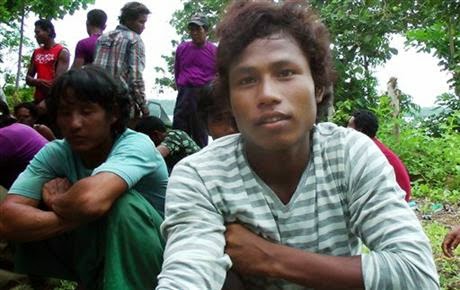
BENJINA, Indonesia (AP) — The Burmese slaves sat on the floor and stared through the rusty bars of their locked cage, hidden on a tiny tropical island thousands of miles from home.
Just a few yards away, other workers loaded cargo ships with slave-caught seafood that clouds the supply networks of major supermarkets, restaurants and even pet stores in the United States.
But the eight imprisoned men were considered flight risks — laborers who might dare run away. They lived on a few bites of rice and curry a day in a space barely big enough to lie down, stuck until the next trawler forces them back to sea.
"All I did was tell my captain I couldn't take it anymore, that I wanted to go home," said Kyaw Naing, his dark eyes pleading into an Associated Press video camera sneaked in by a sympathetic worker. "The next time we docked," he said nervously out of earshot of a nearby guard, "I was locked up."
Here, in the Indonesian island village of Benjina and the surrounding waters, hundreds of trapped men represent one of the most desperate links criss-crossing between companies and countries in the seafood industry. This intricate web of connections separates the fish we eat from the men who catch it, and obscures a brutal truth: Your seafood may come from slaves.
The men the AP interviewed on Benjina were mostly from Myanmar, also known as Burma, one of the poorest countries in the world. They were brought to Indonesia through Thailand and forced to fish. Their catch was then shipped back to Thailand, where it entered the global stream of commerce.
Tainted fish can wind up in the supply chains of some of America's major grocery stores, such as Kroger, Albertsons and Safeway; the nation's largest retailer, Wal-Mart; and the biggest food distributor, Sysco. It can find its way into the supply chains of some of the most popular brands of canned pet food, including Fancy Feast, Meow Mix and Iams. It can turn up as calamari at fine dining restaurants, as imitation crab in a California sushi roll or as packages of frozen snapper relabeled with store brands that land on our dinner tables.
In a year-long investigation, the AP talked to more than 40 current and former slaves in Benjina. The AP documented the journey of a single large shipment of slave-caught seafood from the Indonesian village, tracking it by satellite to a gritty Thai harbor. Upon its arrival, AP journalists followed trucks that loaded and drove the seafood over four nights to dozens of factories, cold storage plants and the country's biggest fish market.
The tainted seafood mixes in with other fish at a number of sites in Thailand, including processing plants. U.S. Customs records show that several of those Thai factories ship to America. They also sell to Europe and Asia, but the AP traced shipments to the U.S., where trade records are public.
By this time, it is nearly impossible to tell where a specific fish caught by a slave ends up. However, entire supply chains are muddied, and money is trickling down the line to companies that benefit from slave labor.
The major corporations contacted would not speak on the record but issued statements that strongly condemned labor abuses. All said they were taking steps to prevent forced labor, such as working with human rights groups to hold subcontractors accountable.
Several independent seafood distributors who did comment described the costly and exhaustive steps taken to ensure their supplies are clean. They said the discovery of slaves underscores how hard it is to monitor what goes on halfway around the world.
Santa Monica Seafood, a large independent importer that sells to restaurants, markets and direct from its store, has been a leader in improving international fisheries, and sends buyers around the world to inspect vendors.
"The supply chain is quite cloudy, especially when it comes from offshore," said Logan Kock, vice president for responsible sourcing, who acknowledged that the industry recognizes and is working to address the problem. "Is it possible a little of this stuff is leaking through? Yeah, it is possible. We are all aware of it."
The slaves interviewed by the AP had no idea where the fish they caught was headed. They knew only that it was so valuable, they were not allowed to eat it.
They said the captains on their fishing boats forced them to drink unclean water and work 20- to 22-hour shifts with no days off. Almost all said they were kicked, whipped with toxic stingray tails or otherwise beaten if they complained or tried to rest. They were paid little or nothing, as they hauled in heavy nets with squid, shrimp, snapper, grouper and other fish.
Some shouted for help over the deck of their trawler in the port to reporters, as bright fluorescent lights silhouetted their faces in the darkness.
"I want to go home. We all do," one man called out in Burmese, a cry repeated by others. The AP is not using the names of some men for their safety. "Our parents haven't heard from us for a long time. I'm sure they think we are dead."
Another glanced fearfully over his shoulder toward the captain's quarters, and then yelled: "It's torture. When we get beaten, we can't do anything back. ... I think our lives are in the hands of the Lord of Death."
In the worst cases, numerous men reported maimings or even deaths on their boats.
"If Americans and Europeans are eating this fish, they should remember us," said Hlaing Min, 30, a runaway slave from Benjina. "There must be a mountain of bones under the sea. ... The bones of the people could be an island, it's that many."
_______
For Burmese slaves, Benjina is the end of the world.
Roughly 3,500 people live in the town that straddles two small islands separated by a five-minute boat ride. Part of the Maluku chain, formerly known as the Spice Islands, the area is about 400 miles north of Australia, and hosts small kangaroos and rare birds of paradise with dazzling bright feathers.
Benjina is impossible to reach by boat for several months of the year, when monsoon rains churn the Arafura Sea. It is further cut off by a lack of Internet access. Before a cell tower was finally installed last month, villagers would climb nearby hills each evening in the hope of finding a signal strong enough to send a text. An old landing strip has not been used in years.
The small harbor is occupied by Pusaka Benjina Resources, whose five-story office compound stands out and includes the cage with the slaves. The company is the only fishing operation on Benjina officially registered in Indonesia, and is listed as the owner of more than 90 trawlers. However, the captains are Thai, and the Indonesian government is reviewing to see if the boats are really Thai-owned. Pusaka Benjina did not respond to phone calls and a letter, and did not speak to a reporter who waited for two hours in the company's Jakarta office.
On the dock in Benjina, former slaves unload boats for food and pocket money. Many are men who were abandoned by their captains — sometimes five, 10 or even 20 years ago — and remain stranded.
In the deeply forested island interiors, new runaways forage for food and collect rainwater, living in constant fear of being found by hired slave catchers.
And just off a beach covered in sharp coral, a graveyard swallowed by the jungle entombs dozens of fishermen. They are buried under fake Thai names given to them when they were tricked or sold onto their ships, forever covering up evidence of their captors' abuse, their friends say.
"I always thought if there was an entrance there had to be an exit," said Tun Lin Maung, a slave abandoned on Benjina, as other men nodded or looked at the ground. "Now I know that's not true."
The Arafura Sea provides some of the world's richest and most diverse fishing grounds, teeming with mackerel, tuna, squid and many other species.
Although it is Indonesian territory, it draws many illegal fishing fleets, including from Thailand. The trade that results affects the United States and other countries.
The U.S. counts Thailand as one of its top seafood suppliers, and buys about 20 percent of the country's $7 billion annual exports in the industry. Last year, the State Department blacklisted Thailand for failing to meet minimum standards in fighting human trafficking, placing the country in the ranks of North Korea, Syria and Iran. However, there were no additional sanctions.
Thailand's seafood industry is largely run off the backs of migrant laborers, said Kendra Krieder, a State Department analyst who focuses on supply chains. The treatment of some of these workers falls under the U.S. government's definition of slavery, which includes forcing people to keep working even if they once signed up for the jobs, or trafficking them into situations where they are exploited.
"In the most extreme cases, you're talking about someone kidnapped or tricked into working on a boat, physically beaten, chained," said Krieder. "These situations would be called modern slavery by any measure."
The Thai government says it is cleaning up the problem. On the bustling floor of North America's largest seafood show in Boston earlier this month, an official for the Department of Fisheries laid out a plan to address labor abuse, including new laws that mandate wages, sick leave and shifts of no more than 14 hours. However, Kamonpan Awaiwanont stopped short when presented details about the men in Benjina.
"This is still happening now?" he asked. He paused. "We are trying to solve it. This is ongoing."
The Thai government also promises a new national registry of illegal migrant workers, including more than 100,000 flooding the seafood industry. However, policing has now become even harder because decades of illegal fishing have depleted stocks close to home, pushing the boats farther and deeper into foreign waters.
The Indonesian government has called a temporary ban on most fishing, aiming to clear out foreign poachers who take billions of dollars of seafood from the country's waters. As a result, more than 50 boats are now docked in Benjina, leaving up to 1,000 more slaves stranded onshore and waiting to see what will happen next.
Indonesian officials are trying to enforce laws that ban cargo ships from picking up fish from boats at sea. This practice forces men to stay on the water for months or sometimes years at a time, essentially creating floating prisons.
Susi Pudjiastuti, the new Fisheries Minister, said she has heard of different fishing companies putting men in cells. She added that she believes the trawlers on Benjina may really have Thai owners, despite the Indonesian paperwork, reflecting a common practice of faking or duplicating licenses.
She said she is deeply disturbed about the abuse on Benjina and other islands.
"I'm very sad. I lose my eating appetite. I lose my sleep," she said. "They are building up an empire on slavery, on stealing, on fish(ing) out, on massive environmental destruction for a plate of seafood."
_________
The story of slavery in the Thai seafood industry started decades ago with the same push-and-pull that shapes economic immigration worldwide — the hope of escaping grinding poverty to find a better life somewhere else.
In recent years, as the export business has expanded, it has become more difficult to convince young Burmese or Cambodian migrants and impoverished Thais — all of whom were found on Benjina — to accept the dangerous jobs. Agents have become more desperate and ruthless, recruiting children and the disabled, lying about wages and even drugging and kidnapping migrants, according to a former broker who spoke on condition of anonymity to avoid retribution.
The broker said agents then sell the slaves, usually to Thai captains of fishing boats or the companies that own them. Each slave typically costs around $1,000, according to Patima Tungpuchayakul, manager of the Thai-based nonprofit Labor Rights Promotion Network Foundation. The men are later told they have to work off the "debt" with wages that don't come for months or years, or at all.
"The employers are probably more worried about the fish than the workers' lives," she said. "They get a lot of money from this type of business."
Illegal Thai boats are falsely registered to fish in Indonesia through graft, sometimes with the help of government authorities. Praporn Ekouru, a Thai former member of Parliament, admitted to the AP that he had bribed Indonesian officials to go into their waters, and complained that the Indonesian government's crackdown is hurting business.
"In the past, we sent Thai boats to fish in Indonesian waters by changing their flags," said Praporn, who is also chairman of the Songkhla Fisheries Association in southern Thailand. "We had to pay bribes of millions of baht per year, or about 200,000 baht ($6,100) per month. ... The officials are not receiving money anymore because this order came from the government."
Illegal workers are given false documents, because Thai boats cannot hire undocumented crew. One of the slaves in Benjina, Maung Soe, said he was given a fake seafarer book belonging to a Thai national, accepted in Indonesia as an informal travel permit. He rushed back to his boat to dig up a crinkled copy.
"That's not my name, not my signature," he said angrily, pointing at the worn piece of paper. "The only thing on here that is real is my photograph."
Soe said he had agreed to work on a fishing boat only if it stayed in Thai waters, because he had heard Indonesia was a place from which workers never came back.
"They tricked me," he said. "They lied to me. ... They created fake papers and put me on the boat, and now here I am in Indonesia."
The slaves said the level of abuse on the fishing boats depends on individual captains and assistants. Aung Naing Win, who left a wife and two children behind in Myanmar two years ago, said some fishermen were so depressed that they simply threw themselves into the water. Win, 40, said his most painful task was working without proper clothing in the ship's giant freezer, where temperatures drop to 39 degrees below zero.
"It was so cold, our hands were burning," he said. "No one really cared if anyone died."
________
The shipment the AP tracked from the port of Benjina carried fish from smaller trawlers; AP journalists talked to slaves on more than a dozen of them.
A crane hoisted the seafood onto a refrigerated cargo ship called the Silver Sea Line, with an immense hold as big as 50 semi-trucks. At this point, by United Nations and U.S. standards, every fish in that hold is considered associated with slavery.
The ship belongs to the Silver Sea Reefer Co., which is registered in Thailand and has at least nine refrigerated cargo boats. The company said it is not involved with the fishermen.
"We only carry the shipment and we are hired in general by clients," said owner Panya Luangsomboon. "We're separated from the fishing boats."
The AP followed the Silver Sea Line by satellite over 15 days to Samut Sakhon. When it arrived, workers on the dock packed the seafood over four nights onto more than 150 trucks, which then delivered their loads around the city.
One truck bore the name and bird logo of Kingfisher Holdings Ltd., which supplies frozen and canned seafood around the world. Another truck went to Mahachai Marine Foods Co., a cold storage business that also supplies to Kingfisher and other exporters, according to Kawin Ngernanek, whose family runs it.
"Yes, yes, yes, yes," said Kawin, who also serves as spokesman for the Thai Overseas Fisheries Association. "Kingfisher buys several types of products."
When asked about abusive labor practices, Kingfisher did not answer repeated requests for comment. Mahachai manager Narongdet Prasertsri responded, "I have no idea about it at all."
Every month, Kingfisher and its subsidiary KF Foods Ltd. sends about 100 metric tons of seafood from Thailand to America, according to U.S. Customs Bills of Lading. These shipments have gone to Santa Monica Seafood, Stavis Seafoods — located on Boston's historic Fish Pier — and other distributors.
Richard Stavis, whose grandfather started the dealership in 1929, shook his head when told about the slaves whose catch may end up at businesses he buys from. He said his company visits processors and fisheries, requires notarized certification of legal practices and uses third-party audits.
"The truth is, these are the kind of things that keep you up at night," he said. "That's the sort of thing I want to stop. ... There are companies like ours that care and are working as hard as they can."
Wholesalers like Stavis sell packages of fish, branded and unbranded, that can end up on supermarket shelves with a private label or house brand. Stavis' customers also include Sysco, the largest food distributor in the U.S.; there is no clear way to know which particular fish was sold to them.
Sysco declined an interview, but the company's code of conduct says it "will not knowingly work with any supplier that uses forced, bonded, indentured or slave labor."
Gavin Gibbons, a spokesman for National Fisheries Institute, which represents about 75 percent of the U.S. seafood industry, said the reports of abuse were "disturbing" and "disheartening." ''But these type of things flourish in the shadows," he said.
A similar pattern repeats itself with other shipments and other companies, as the supply chain splinters off in many directions in Samut Sakhon. It is in this Thai port that slave-caught seafood starts to lose its history.
The AP followed another truck to Niwat Co., which sells to Thai Union Manufacturing Co., according to part owner Prasert Luangsomboon. Weeks later, when confronted about forced labor in their supply chain, Niwat referred several requests for comment to Luangsomboon, who could not be reached for further comment.
Thai Union Manufacturing is a subsidiary of Thai Union Frozen Products PCL., the country's largest seafood corporation, with $3.5 billion in annual sales. This parent company, known simply as Thai Union, owns Chicken of the Sea and is buying Bumble Bee, although the AP did not observe any tuna fisheries. In September, it became the country's first business to be certified by Dow Jones for sustainable practices, after meeting environmental and social reviews.
Thai Union said it condemns human rights violations, but multiple stakeholders must be part of the solution. "We all have to admit that it is difficult to ensure the Thai seafood industry's supply chain is 100 percent clean," CEO Thiraphong Chansiri said in an emailed statement.
Thai Union ships thousands of cans of cat food to the U.S., including household brands like Fancy Feast, Meow Mix and Iams. These end up on shelves of major grocery chains, such as Kroger, Safeway and Albertsons, as well as pet stores; again, however, it's impossible to tell if a particular can of cat food might have slave-caught fish.
Thai Union says its direct clients include Wal-Mart, which declined an interview but said in an email statement: "We care about the men and women in our supply chain, and we are concerned about the ethical recruitment of workers."
Wal-Mart described its work with several non-profits to end forced labor in Thailand, including Project Issara, and referred the AP to Lisa Rende Taylor, its director. She noted that slave-caught seafood can slip into supply chains undetected at several points, such as when it is traded between boats or mingles with clean fish at processing plants. She also confirmed that seafood sold at the Talay Thai market — to where the AP followed several trucks — can enter international supply chains.
"Transactions throughout Thai seafood supply chains are often not well-documented, making it difficult to estimate exactly how much seafood available on supermarket shelves around the world is tainted by human trafficking and forced labor," she said.
Poj Aramwattananont, president of an industry group that represents Thai Union, Kingfisher and others, said Thais are not "jungle people" and know that human trafficking is wrong. However, he acknowledged that Thai companies cannot always track down the origins of their fish.
"We don't know where the fish come from when we buy from Indonesia," said Poj of the Thai Frozen Foods Association. "We have no record. We don't know if that fish is good or bad."
______
The seafood the slaves on Benjina catch may travel around the world, but their own lives often end right here, in this island village.
A crude cemetery holds more than graves strangled by tall grasses and jungle vines, where small wooden markers are neatly labelled, some with the falsified names of slaves and boats. Only their friends remember where they were laid to rest.
In the past, former slave Hla Phyo said, supervisors on ships simply tossed bodies into the sea to be devoured by sharks. But after authorities and companies started demanding that every man be accounted for on the roster upon return, captains began stowing corpses alongside the fish in ship freezers until they arrived back in Benjina, the slaves said.
Lifting his knees as he stepped over the thick brush, Phyo searched for two grave markers overrun by weeds — friends he helped bury.
It's been five years since he himself escaped the sea and struggled to survive on the island. Every night, his mind drifts back to his mother in Myanmar. He knows she must be getting old now, and he desperately wants to return to her. Standing among so many anonymous tombs stacked on top of each other, hopelessness overwhelms him.
"I'm starting to feel like I will be in Indonesia forever," he said, wiping a tear away. "I remember thinking when I was digging, the only thing that awaits us here is death."
___
Esther Htusan contributed to this report from Benjina, Indonesia. Mason reported from Samut Sakhon, Thailand; Mendoza reported from Boston, Massachusetts.
AP By ROBIN MCDOWELL, MARGIE MASON and MARTHA MENDOZA